Vera Rubin Platform Breakdown: 7 Chips, 5 Racks, and a 10x Inference Efficiency Leap
Nvidia’s Vera Rubin platform is easiest to understand as a coordinated AI infrastructure system, not simply a new GPU surrounded by accessories. Its components divide responsibility across computation, networking, storage, and orchestration so that fewer resources sit idle while another part of the system becomes a bottleneck.

The headline needs two clarifications. “Seven chips” means seven major chip designs, not seven physical devices. “Five racks” means five specialized rack-scale system types, not a complete installation containing exactly five cabinets. Nvidia’s March 2026 technical description presents a 40-rack POD configuration containing multiple instances of those systems.
The central idea is coordination. Nvidia claims up to ten times higher inference throughput per watt than Blackwell in defined comparisons. That is a platform-level claim, not a promise that every application becomes ten times faster.
The Seven-Chip Lineup
The platform combines computing and infrastructure processors with different responsibilities.
- Vera CPU handles host processing and orchestration.
- Rubin GPU provides accelerated computation.
- NVLink 6 Switch connects GPUs within the scale-up domain.
- ConnectX-9 SuperNIC connects computing resources to the wider network.
- BlueField-4 DPU supports infrastructure and data services.
- Spectrum-6 Ethernet switch silicon provides network switching.
- Groq 3 LPU adds specialized low-latency inference capability.
Nvidia originally introduced Rubin with six principal chips in January 2026. The expanded March platform incorporated Groq-derived inference technology as the seventh.
The Five Rack-Scale Systems
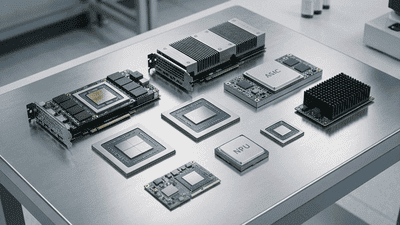
Those chip designs support five distinct system roles.
- Vera Rubin NVL72 is the GPU-centered computing rack.
- Vera CPU racks provide additional CPU resources.
- Groq 3 LPX racks target latency-sensitive inference.
- Vera BlueField-4 STX racks provide storage and data infrastructure.
- Spectrum-6 SPX racks provide Ethernet networking.
The relationship is not one chip per rack. Several processor types appear together, and a deployment can contain multiple racks of a given type.
That distinction makes the architecture understandable: seven building-block designs support five specialized infrastructure functions.
Why the Platform Extends Beyond the GPU
An accelerator needs data, memory, communication, and software to remain productive.
When one of those resources falls behind, expensive computing capacity can spend time waiting.
Adding more GPUs does not automatically correct the imbalance.
Vera Rubin’s broader design attempts to address the complete execution path. The commercial proposition is that coordinated components can deliver more useful work than an equally impressive collection of poorly matched parts.
Vera Rubin NVL72 Is the Main Compute Engine
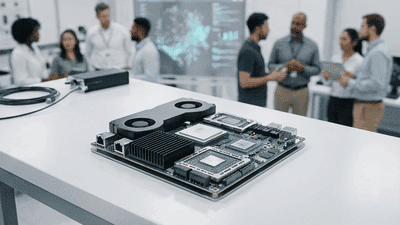
The NVL72 rack integrates 72 Rubin GPUs and 36 Vera CPUs, connected through NVLink 6 and supported by networking and infrastructure processors.
Nvidia describes the GPUs as participating in a large scale-up domain intended for demanding training and inference workloads.
The arrangement matters because large models often need resources distributed across devices.
But the rack is not one enormous monolithic processor. Software, communication, and workload partitioning still determine how effectively the combined resources operate.
Vera CPUs Do More Than Feed Instructions
The CPU side handles functions that do not belong entirely on the accelerator.
These can include orchestration, application logic, data preparation, and coordination with external services.
Dedicated Vera CPU racks extend that resource pool beyond the CPUs integrated into the NVL72 computing rack.
This is particularly relevant to agentic workloads, which can alternate between model execution and conventional software activity. More accelerator capability provides limited value if the surrounding application cannot keep pace.
Rubin’s Memory Configuration Addresses Two Constraints
AI workloads need enough memory to hold model weights and working state, along with sufficient bandwidth to move that information.
Capacity and bandwidth are different resources.
A model may fit but execute inefficiently, or require distribution across devices even when local bandwidth is substantial.
Rubin’s HBM4-based memory system is intended to improve both dimensions. Its practical benefit depends on how the workload uses the memory rather than the specification alone.
NVLink 6 Handles the Scale-Up Domain
Scale-up communication connects processors participating closely in one computing system.
It needs to support frequent exchanges without excessive overhead.
NVLink 6 provides that role within Vera Rubin’s GPU domain, while the associated switch architecture organizes connectivity among the devices.
For users, the important result is efficient distributed execution. A high link bandwidth is useful only when the application and communication software can use it effectively.
ConnectX-9 and Spectrum-6 Address a Different Network
The wider network connects systems across the deployment.
ConnectX-9 SuperNICs provide endpoints, while Spectrum-6 switch systems move traffic through the Ethernet fabric.
This role is distinct from local HBM access or GPU scale-up communication.
The distinction matters when evaluating bottlenecks. Memory bandwidth, NVLink performance, and Ethernet capacity describe different paths; their headline figures cannot be added together into one universal data-transfer rate.
BlueField-4 STX Makes Storage Part of the Architecture
Large AI systems need to read, retain, and manage substantial amounts of data.
Long-context inference also creates growing demands for working-state storage and retrieval.
The STX system addresses data infrastructure rather than serving as another arithmetic accelerator.
Its importance lies in reducing the likelihood that storage and data services prevent the computing racks from remaining productive. The platform’s efficiency depends on the full pipeline, not only its fastest component.
Groq 3 LPX Adds a Specialized Inference Path
Groq-derived LPUs emphasize predictable execution and rapid access to on-chip SRAM.
LPX applies those characteristics at rack scale alongside Vera Rubin rather than replacing the GPU platform.
The division of work can place latency-sensitive operations on specialized hardware while retaining other functions on GPUs.
That makes the platform heterogeneous: different processor architectures contribute according to their strengths. The benefit must exceed the communication and scheduling overhead introduced by splitting the work.
Prefill and Decode Explain the Need for Different Resources
Language-model inference commonly begins with processing an input prompt, followed by generating output tokens.
Prompt processing can expose substantial parallel computation. Autoregressive generation introduces sequential dependencies between steps.
The resource balance varies with context length, model architecture, and concurrency.
A coordinated platform can optimize these phases differently. But assigning work requires a capable serving runtime; the hardware arrangement alone does not establish the best execution strategy.
The 10x Claim Describes Inference Efficiency
Nvidia’s current NVL72 product material claims up to ten times more tokens per megawatt than GB200 NVL72, alongside one-tenth the cost per million tokens in its comparison.
These are different metrics: one measures output relative to power, while the other describes an economic outcome.
Neither should be rewritten as ten times faster execution for every request.
The comparison needs the model, precision, concurrency, software, and system configuration. “Up to” identifies a best-case or defined scenario, not a universal result.
There Is a Reported Workload Behind the Headline
In July 2026, Nvidia reported that CoreWeave had run a DeepSeek-R1 benchmark on Vera Rubin NVL72 and achieved a tenfold improvement in tokens per second per megawatt relative to Grace Blackwell NVL72.
That adds workload context to the efficiency claim.
It remains a result communicated through Nvidia’s platform announcement, not independent proof across all serving environments.
For buyers, the sensible next step is equivalent testing of their own models and service requirements.
Other Large Multipliers Describe Different Scenarios
Nvidia’s March announcement also claimed up to 35 times higher inference throughput per megawatt when LPX and Vera Rubin are combined for trillion-parameter models.
That is a separate heterogeneous-system scenario.
It should not be added to the tenfold NVL72 figure or treated as the same baseline comparison.
For readers, preserving the configuration and workload prevents impressive marketing numbers from becoming mathematically meaningless.
The Training Claim Needs Its Own Boundary
Nvidia also says Vera Rubin can train large mixture-of-experts models using one-quarter as many GPUs as the Blackwell comparison.
That describes a particular training result or projection, not a universal reduction in resources.
Model structure, numerical representation, communication, and software affect the outcome.
A fourfold reduction in device count also does not automatically mean a fourfold reduction in total cost. Accelerator prices, infrastructure, and operating requirements remain part of the calculation.
Agentic AI Makes Coordination More Valuable
An agent can generate text, call tools, inspect results, and continue through several stages before completing a task.
Those stages create demand beyond the accelerator itself.
CPUs, networking, storage, and external software can become important contributors to response time.
The five-system architecture reflects that broader workload. Its value is greatest when the complete task finishes more efficiently, not merely when one model operation achieves a stronger benchmark.
Power Efficiency Does Not Eliminate Facility Requirements
A platform can deliver more useful output per watt while still requiring substantial total electricity and cooling.
Higher density also changes the demands placed on electrical distribution and heat removal.
Operators need suitable facilities before equipment can reach sustained production use.
For deployment forecasts, manufacturing readiness and site readiness should remain separate. A completed rack is not productive infrastructure until power, cooling, networking, and operations are prepared.
Production Status Is Not the Same as Fleet Availability
Nvidia’s March announcement described the seven-chip platform as entering full production, while subsequent communications discussed partner ramps and deployments.
Those statements concern different stages of commercialization.
A chip design can be in production while specific rack configurations remain limited or follow customer schedules.
For buyers, the relevant evidence is the availability of the exact system they need. Broad platform status should not substitute for a confirmed delivery and commissioning plan.
The Investment Case Extends Across the Supply Chain
Vera Rubin requires logic fabrication, HBM, packaging, substrates, servers, networking, and facility infrastructure.
Each stage has different capacity requirements and lead times.
Growth in one area can expose constraints elsewhere.
For investors, the opportunity is therefore broader than GPU volume, but also more complicated. Suppliers benefit according to their qualified role, execution, and economics—not merely their association with the platform.
A Practical Checklist for Evaluating the Leap
The strongest comparisons connect architecture with real operating conditions.
- Distinguish chip designs from physical device counts.
- Separate rack types from the number of racks deployed.
- Identify the exact configuration behind each multiplier.
- Measure latency, throughput, and power efficiency separately.
- Hold model quality and numerical precision appropriately consistent.
- Include communication and serving overhead.
- Track availability, commissioning, and sustained utilization.
- Compare total operating cost rather than peak capability alone.
These questions reveal whether the platform advantage becomes customer value.
The Breakthrough Is the System Working Together
Vera Rubin’s seven-chip, five-system design represents a coordinated approach to AI infrastructure. GPUs provide computation, CPUs manage surrounding work, networking connects resources, storage supports data flow, and LPUs add specialized inference capability.
The tenfold efficiency claim is meaningful only within its stated comparison.
The lasting result will be measured in productive deployments: more acceptable AI work from available power and capital. That is the real promise behind the platform—and the standard by which the leap should be judged.